Intellectual framework
AI Value Migration Framework
How democratised capability reshapes competitive advantage
Version 1.1 — September 2026
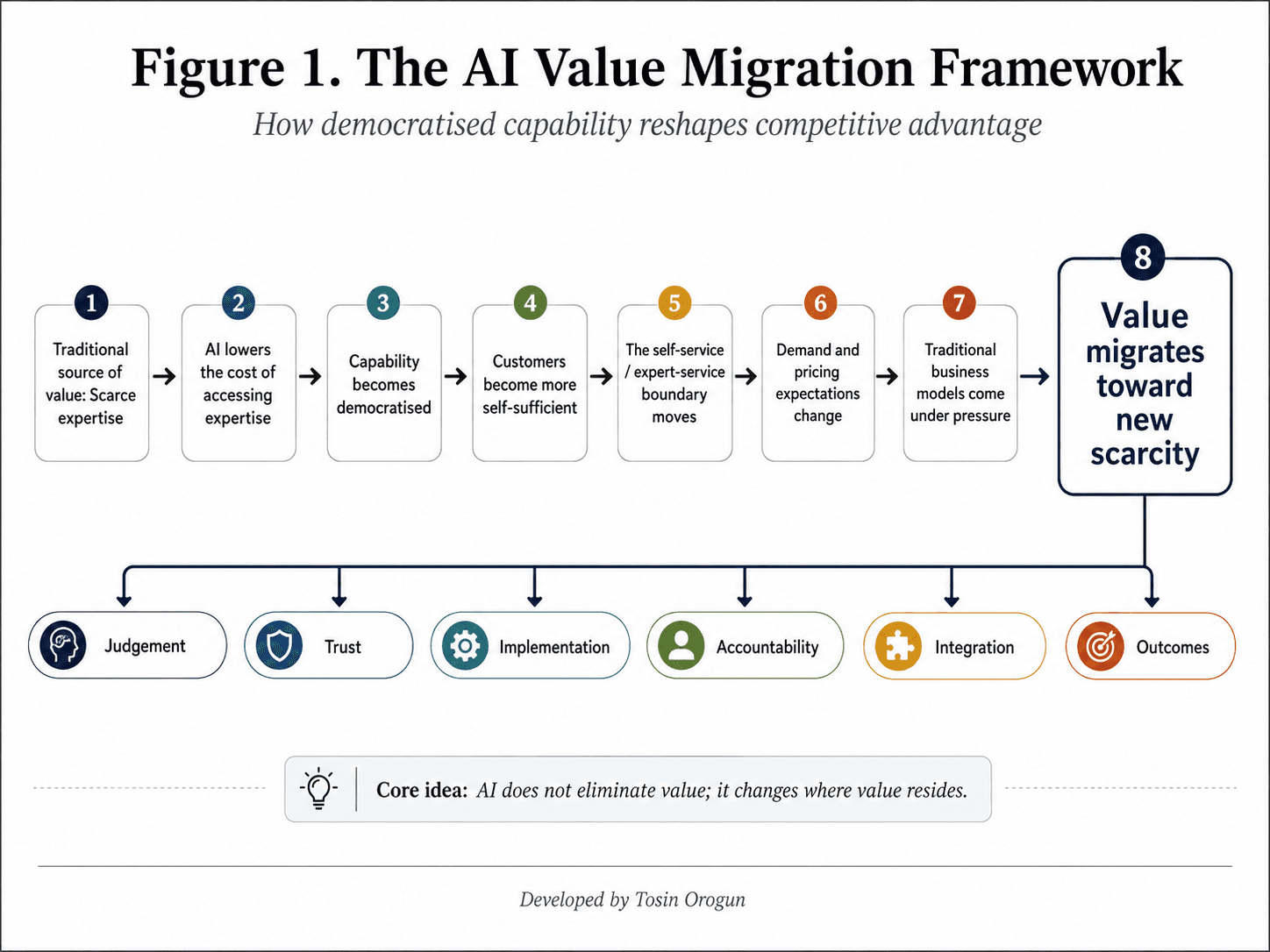
AI does not eliminate value; it changes where value resides as previously scarce capabilities become easier, cheaper and more widely accessible.
The question
Artificial intelligence is changing more than how organizations perform work. It is changing the economics of capability itself: who can access expertise, how quickly they can access it, how much that access costs, and how dependent they remain on specialists once the capability becomes easier to obtain.
Much of the discussion about AI focuses on what organizations can automate internally. That is important, but it captures only part of the economic change. AI is also increasing the capability of customers, employees, entrepreneurs and smaller competitors. Tasks that once required specialist knowledge, significant time or expensive professional support can increasingly be performed with intelligent assistance.
That creates a strategic question that extends beyond automation:
What happens when capabilities for which customers once depended on specialists become increasingly accessible to customers themselves?
When the answer is greater self-sufficiency, the consequences can extend into demand, pricing expectations, service boundaries, competitive advantage and business models. A capability can remain valuable while the location of that value changes.
The AI Value Migration Framework provides a structured way to examine that shift.
How the framework works
The AI Value Migration Framework examines how falling barriers to expertise can change where economic value resides.
Its central idea is not that expertise disappears. It is that when one layer of capability becomes abundant, value can migrate toward whatever remains difficult, differentiated or scarce.
The framework begins from a familiar economic condition: specialist expertise is valuable partly because access to it is limited. People pay professionals, firms or institutions because those actors possess knowledge, experience, systems or capabilities that are difficult to reproduce independently.
Artificial intelligence changes that equation by lowering the cost of accessing certain forms of capability. Knowledge can be synthesized more quickly. Routine analysis can be performed faster. First drafts, recommendations, explanations and other previously time-intensive outputs can become widely available.
As those capabilities become democratized, customers and workers can become more self-sufficient. The boundary between what people can do themselves and what they still require experts to do begins to move.
That shift has consequences. Demand changes. Pricing expectations change. The premium attached to routine execution can decline. Traditional business models built around scarce access to capability may come under pressure.
But this does not mean economic value disappears. Instead, value tends to migrate toward the capabilities that remain scarce after the original capability becomes easier to access.
The framework therefore asks a deliberately simple question:
Where did the value move?
How value migrates
1. Traditional source of value: scarce expertise
Many professional and business models begin with an asymmetry of capability. One party possesses knowledge, tools, experience or access that another party does not. That scarcity creates economic value. Customers pay for expertise because reproducing the capability independently would be difficult, expensive or time-consuming. The stronger the dependency on specialist capability, the greater the opportunity to charge for access to it.
2. AI lowers the cost of accessing expertise
Artificial intelligence can reduce the time, cost and effort required to access capabilities that previously depended heavily on specialists. This does not mean AI reproduces every dimension of professional expertise. It means that certain parts of the capability. i.e information retrieval, synthesis, analysis, drafting, explanation, pattern recognition or routine decision support, become easier to obtain. The economic significance lies in the reduced barrier to access.
3. Capability becomes democratized
As access costs fall, capabilities that were once concentrated among specialists become available to a much broader group of people. Individuals, employees, entrepreneurs and smaller organizations may gain access to tools or outputs that previously required larger budgets, specialist teams or external professional support. The capability becomes less exclusive, and exclusivity is often one of the foundations of its economic premium.
4. Customers become more self-sufficient
Greater access to capability changes what customers can do for themselves. A customer who once needed an expert to begin a task may now arrive with research completed, options identified, a first draft prepared or part of the problem already solved. This does not necessarily remove the need for specialists. It changes the starting point of the relationship. Customers become more capable participants in the value-creation process.
5. The self-service / expert-service boundary moves
As customers become more capable, the line between self-service and expert service begins to shift. Activities that once justified professional intervention may increasingly be handled independently, while expert involvement becomes concentrated around more complex, consequential or ambiguous parts of the problem. The strategic issue is therefore not simply whether customers will continue to need experts. It is which parts of the service they will still be willing to pay experts to perform.
6. Demand and pricing expectations change
When customers can perform more of the work themselves, their expectations of professional services can change. They may become less willing to pay premium prices for routine execution, standardized outputs or information they can now obtain elsewhere at much lower cost. At the same time, they may become more willing to pay for capabilities that remain difficult: interpretation, judgment, trusted advice, implementation, accountability or outcomes. The demand does not necessarily vanish; its composition changes.
7. Traditional business models come under pressure
Business models built primarily around controlling access to previously scarce capability may become vulnerable when that capability becomes widely accessible. Organizations may find that what once differentiated them is increasingly available to competitors, customers or employees through common technology. The pressure can appear through lower prices, declining demand for routine services, changing customer expectations or the emergence of new competitors with lower cost structures. The challenge is not simply to automate the old business model more efficiently. It is to determine whether the basis of the old value proposition is changing.
8. Value migrates toward new scarcity
When one source of scarcity weakens, economic value can migrate toward capabilities that remain difficult to reproduce. Those capabilities may include judgment, trust, implementation, accountability, integration and the ability to deliver meaningful outcomes. The framework therefore does not predict the disappearance of expertise. It suggests that the location of the premium may change. The strategic task is to identify the new scarcity before competitors, customers and markets fully adjust to it.
Where new scarcity emerges
Judgement
As information and analysis become more abundant, the ability to decide what matters can become more valuable. Judgement involves weighing incomplete information, understanding context, recognizing trade-offs and making decisions when the answer is not obvious. AI can expand the information available to decision-makers, but the economic premium may increasingly reside in determining what should be done with that information.
Trust
When capable tools become widely available, customers may have access to more answers than they can confidently evaluate. Trust becomes valuable when people need to know whose interpretation, recommendation or decision they can rely on. Professional reputation, credibility, transparency and demonstrated expertise may therefore become more important rather than less.
Implementation
Knowing what should be done is different from making it happen. AI can reduce the cost of analysis, planning and recommendation, but organizations and individuals still face the difficulty of translating ideas into operational reality. Implementation capability: coordinating people, systems, processes and change, can therefore become an important source of new scarcity.
Accountability
When decisions have consequences, customers and organizations often need more than an answer. They need someone who is prepared to stand behind the decision. Accountability includes responsibility, professional oversight, governance, risk ownership and the willingness to be answerable for outcomes. As automated recommendations become abundant, accountable human or institutional responsibility can become more valuable.
Integration
Organizations rarely operate through one tool, one process or one source of information. Value increasingly depends on the ability to integrate technology, people, workflows, data and business objectives into a coherent system. The challenge is often not accessing capability; it is making different capabilities work together effectively. Integration therefore becomes a strategic source of value.
Outcomes
Customers ultimately care less about the sophistication of the tool than about whether the desired result is achieved. As execution becomes easier and capability more accessible, value may move away from charging for activity and toward delivering measurable outcomes. Organizations that can connect technology and expertise to meaningful results may therefore capture more value than those that simply provide access to capability.
Practical application
The AI Value Migration Framework can be used as a strategic lens for examining industries, professions, products and business models.
A useful starting point is to identify the capability on which the current value proposition depends. Ask what customers, employees or competitors historically found difficult to do without specialist support. Then examine how AI changes the economics of that capability.
1. Identify the current source of scarcity
What capability, knowledge, access or expertise currently justifies the premium attached to the product or service?
2. Ask what AI makes easier
Which parts of that capability are becoming cheaper, faster or easier to access?
The objective is not to ask whether AI can replace the entire service. It is to identify which components of the existing value proposition are becoming less scarce.
3. Examine customer self-sufficiency
What can customers increasingly do without you?
Can they research, analyze, draft, diagnose, compare, plan or make preliminary decisions that previously required professional support?
4. Reassess the service boundary
Which activities are likely to move toward self-service, and which still require expert involvement?
This is often where the future shape of the offering begins to emerge.
5. Locate the new scarcity
Where does value become harder to reproduce after routine capability becomes abundant? Look particularly at:
Judgement
Trust
Implementation
Accountability
Integration
Outcomes
6. Examine the business model
If customers become more capable, what happens to demand, pricing, differentiation and competitive advantage?
The important question is not simply whether the organization can use AI to reduce costs. It is whether AI is changing what customers are willing to pay the organization for.
7. Reposition around emerging value
Organizations should consider whether they need to redesign services, pricing, customer experience, workforce capability, technology, partnerships or revenue models around the areas where new scarcity is emerging.
The objective is not to defend every historical source of value. It is to move with the value.
The framework can therefore be summarized as a recurring strategic question: What is becoming abundant, what remains scarce, and how should the organization reposition itself?
This framework also provides the conceptual foundation for the Individual AI Value Migration Assessment and the developing Organizational AI Value Migration Assessment, which apply the same value-migration logic at different levels of analysis.
Continue exploring
Related work

The Second Wave of AI Will Test Business Models, Not Payrolls
Published in African Angle, this article examines a less-discussed second wave of AI disruption: not simply the automation of jobs, but the growing ability of customers to perform work they once purchased from professional-service firms. It introduces my AI Value Migration Framework, explaining how democratized capability can shift customer demand, business models, and competitive advantage.
Read at African Angle (opens in a new tab)